
Last Updated: July 29, 2026
Risk Disclaimer: This article is for educational and informational purposes only and does not constitute investment advice. Cryptocurrency prices are extremely volatile, and market-cap rankings change in real time. Always conduct your own research based on project fundamentals, market cycles, liquidity, regulatory environment, and personal risk tolerance before making any investment decisions.
In 2026, more and more users are searching for “top cryptocurrencies 2026,” “best crypto to invest,” and “largest crypto by market cap.” The real question behind these queries isn’t simply “which coin should I buy?”—it’s: Which crypto assets have the largest scale? Does market-cap ranking reflect investment value? And how should a beginner evaluate whether a crypto asset is worth researching?
Market-cap ranking is indeed an important indicator of a crypto asset’s market influence. Generally, a higher market cap means greater trading volume, stronger liquidity, and more attention. But market-cap ranking does not equal future returns, nor does it guarantee safety. A high market cap only shows that the asset has gained broad market recognition—it doesn’t mean it will necessarily appreciate in value.
True investment research goes beyond rankings. Investors must also assess technical foundations, ecosystem development, user adoption, token utility, market demand, regulatory risks, and where we are in the cycle.
For real-time crypto prices, you can check BTC/USDT live price on HIBT, and extend to ETH, BNB, SOL, XRP, and other major assets.
Introduction: Why Focus on the Top 10 Cryptocurrencies by Market Cap in 2026?
The crypto market is no longer just about Bitcoin. Today’s ecosystem comprises a diverse range of assets: stores of value, smart-contract platforms, stablecoins, exchange ecosystem tokens, payment networks, Layer‑1 contenders, meme coins, and RWA-linked assets.
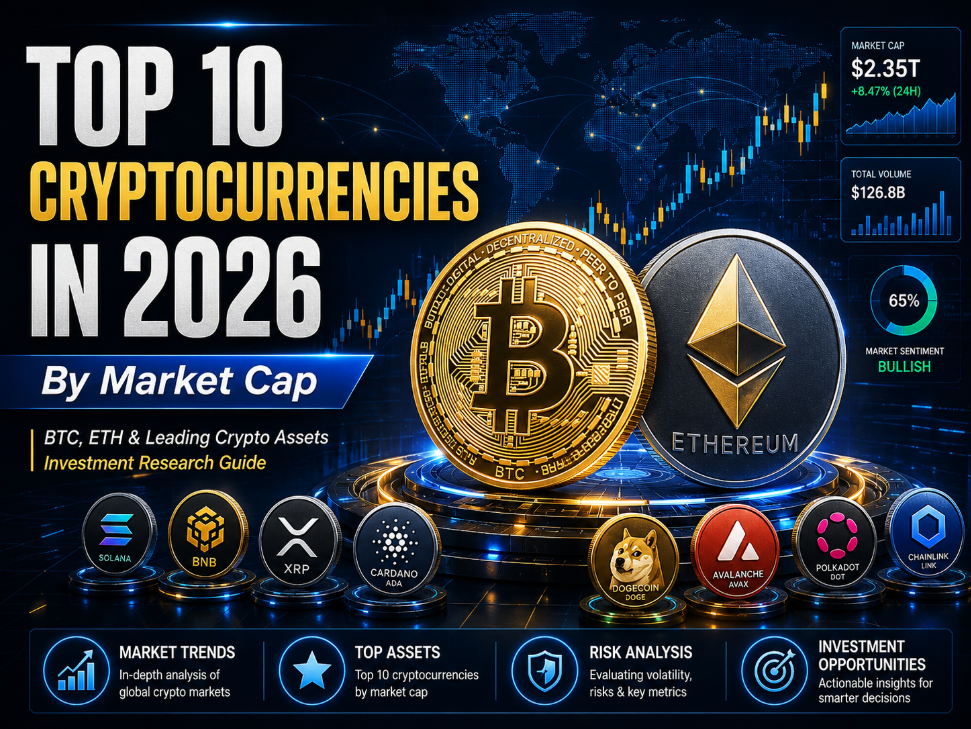
As of the July 29, 2026, CoinGecko snapshot, the top-ranked assets by market cap include Bitcoin, Ethereum, Tether, BNB, USDC, XRP, Solana, TRON, and others. The same data page also shows Dogecoin and Cardano remain high-profile mainstream assets, though their rankings fluctuate in real time. CoinGecko clarifies that its crypto list is ranked by market cap, calculated as the latest price multiplied by circulating supply, with price, volume, and market-cap data updating continuously.
Therefore, this article adopts the HIBT analytical framework—combining “market-cap ranking + mainstream asset representation + user search intent”—to focus on ten major crypto assets most frequently researched by beginners: BTC, ETH, USDT, USDC, BNB, XRP, SOL, TRX, DOGE, and ADA. Note that the real-time top 10 can shift; always refer to live data for current rankings.
1. Understanding the Top 10 Mainstream Crypto Assets by Type (2026)
Looking at real-time market-cap snapshots, as of July 29, 2026, CoinGecko data shows Bitcoin’s market cap at roughly 1.28 trillion, Ethereum ~230.7 billion, Tether ~183.8 billion, BNB ~76 billion, USDC ~72.3 billion, XRP ~67.4 billion, Solana ~42.6 billion, and TRON ~30.8 billion, followed by assets like Figure HELOC and Hyperliquid; Dogecoin ~11 billion and Cardano ~6.1 billion are also in the top tier but not always fixed in the real‑time top 10.
From a beginner’s research perspective, we can group mainstream crypto assets into categories:
- Bitcoin – a store‑of‑value asset, with the narrative of digital gold, scarce supply, and institutional allocation.
- Ethereum – smart‑contract infrastructure, with value derived from DeFi, NFTs, Layer‑2, RWA, and developer ecosystem.
- USDT & USDC – stablecoins used primarily for trading, settlement, cross‑border liquidity, and crypto capital flows.
- BNB – an exchange‑ecosystem and blockchain token, whose value is tied to BNB Chain, the exchange’s ecosystem, Launchpad, and gas fees.
- XRP – a payment network and cross‑border settlement solution, often discussed in the context of institutional payments and fast clearing.
- Solana – a high‑performance Layer‑1 blockchain focused on high throughput, low fees, and a user experience geared toward high‑frequency applications.
- TRON – a stablecoin payment infrastructure, notably for USDT transfers and low‑cost on‑chain payments.
- Dogecoin – a meme coin and community‑driven asset; while technically less complex, it has immense brand recognition and community consensus.
- Cardano – a research‑driven, long‑term roadmap Layer‑1, emphasizing PoS and the Ouroboros consensus mechanism.
These assets are not simply “the best coins to buy,” but rather the most important mainstream crypto assets that beginners should study in 2026.
2. Bitcoin (BTC) – What Is It and Why Is It Still the Largest Crypto?
2.1 Bitcoin Basics
Bitcoin is the first and most influential cryptocurrency. Its initial specification and proof‑of‑concept were released by Satoshi Nakamoto in 2009. Bitcoin.org’s FAQ explains that new bitcoins are issued over time through halvings until the total supply reaches 21 million.
Key facts about BTC:
- Launch Year: 2009
- Blockchain: Bitcoin Network
- Supply: Hard cap of ~21 million BTC
- Consensus: Proof of Work (PoW)
- Asset Type: Store of Value
You can view real‑time Bitcoin price, candlestick charts, volume, and volatility via the BTC/USDT live page.
2.2 Sources of Bitcoin’s Value
Bitcoin has maintained its position as the largest crypto asset for four main reasons:
- Digital Gold Narrative – Bitcoin’s fixed supply, transparent issuance, and lack of reliance on any single company make it a popular hedge against inflation and a store of value.
- Institutional Adoption – With more funds, public companies, asset managers, and ETFs showing interest, BTC has moved beyond the cypherpunk realm into mainstream portfolio discussions.
- ETF Impact – Spot ETFs allow traditional investors to gain BTC exposure through familiar vehicles, lowering the barrier to entry.
- Scarcity – The 21 million supply cap and the halving mechanism are core pillars of Bitcoin’s long‑term investment thesis.
2.3 Bitcoin Investment Risks
Despite being the largest crypto, BTC remains highly risky. It is sensitive to macro liquidity, Fed interest rates, the U.S. dollar index, risk‑asset sentiment, regulatory policies, exchange flows, and ETF inflows/outflows. BTC’s price volatility is significantly higher than that of traditional stocks and bonds. Even if you’re long‑term bullish on Bitcoin, sharp drawdowns are always possible.
2.4 Key Factors to Watch for Bitcoin Going Forward
Three areas deserve close attention:
- ETF Flows – Sustained net inflows could boost institutional demand; persistent outflows may pressure prices.
- Halving Cycles – Halvings reduce new supply, but whether prices rise depends on demand and the macro environment.
- Institutional Allocation – The extent to which traditional institutions incorporate BTC into long‑term portfolios will influence market depth.
You can also explore the Bitcoin price prediction to combine cyclical, flow, and technical data in your analysis.
3. Ethereum (ETH) – The Smart‑Contract Ecosystem Backbone
3.1 What Is Ethereum?
Ethereum is not just the second‑largest crypto—it is the foundational infrastructure for smart contracts and decentralized applications. As Ethereum’s official documentation states, smart contracts are programs that run on the Ethereum blockchain, defining rules and automatically executing them—enabling developers to build financial apps, games, marketplaces, DAOs, NFTs, and more.
In short, Ethereum’s core value isn’t “faster transfers”; it’s “enabling blockchain to run applications.”
3.2 Ethereum’s Ecosystem Value
Ethereum’s ecosystem derives value from multiple sectors:
- DeFi – lending, borrowing, trading, derivatives, and liquidity management.
- NFTs – digital content, gaming assets, collectibles, and membership tokens.
- Layer‑2 – higher throughput and lower fees via Arbitrum, Base, Optimism, and other scaling solutions.
- RWA (Real‑World Assets) – tokenized traditional assets like bonds, funds, equities, and real estate entering the on‑chain financial system.
Together, these sectors underpin ETH’s long‑term value proposition.
3.3 ETH Investment Rationale
Investors are drawn to ETH for three primary reasons:
- Network Effects – Ethereum has the largest developer base, protocol ecosystem, wallets, exchanges, and infrastructure.
- Developer Ecosystem – Most Web3 applications choose Ethereum or its Layer‑2s for deployment.
- Institutional Demand – With growth in RWA, ETFs, stablecoins, DeFi, and Layer‑2s, ETH has become a key research target for institutions exploring crypto infrastructure.
Check the ETH/USDT live price and complement it with the ETH price prediction to track market cycles.
4. Stablecoins – Why Do USDT and USDC Rank Among the Top Cryptos?
Many newcomers wonder: stablecoins trade near $1—why are they among the top by market cap?
The answer: although they don’t appreciate in price, stablecoins are the liquidity backbone of the crypto market.
4.1 What Is USDT?
USDT is a U.S. dollar‑pegged stablecoin issued by Tether, designed to maintain a 1:1 reserve backing. Tether’s public materials state that the company regularly publishes transparency reports on circulating tokens and reserves; Reuters has also reported that USDT functions as a digital dollar backed by reserves.
USDT’s core roles include:
- A quote currency for trading pairs.
- A medium for capital transfers within the crypto market.
- A liquidity vehicle across exchanges.
- A dollar‑based asset management and on‑chain payment tool for users in certain regions.
USDT ranks high not because of price appreciation, but because it is heavily used in trading and settlement.
4.2 What Is USDC?
USDC is a U.S. dollar stablecoin issued by Circle. Circle’s official site states that most USDC reserves are invested in the Circle Reserve Fund, a U.S. SEC‑registered 2a‑7 government money market fund, and emphasizes transparency and reserve disclosures.
USDC is generally perceived as more compliance‑focused, transparent, and enterprise‑oriented, with strong presence in institutional payments, RWA, compliant DeFi, corporate settlements, and cross‑border transactions.
4.3 Future Trends for Stablecoins
Stablecoins are likely to remain one of the most critical infrastructures in crypto. Growth areas include on‑chain payments, cross‑border settlement, RWA trading, DeFi collateral, exchange liquidity pools, corporate settlements, and AI‑agent payments.
However, risks remain: reserve transparency, issuer regulation, redemption capabilities, on‑chain contract vulnerabilities, and varying compliance requirements across jurisdictions.
5. BNB – Exchange Ecosystem Token Analysis
BNB derives its value from the exchange ecosystem, its native blockchain, and real‑world use cases. According to BNB Chain’s governance documentation, the BNB Chain Governance DAO allows users to delegate voting rights, submit proposals, participate in votes, and execute on‑chain code changes; BNB Smart Chain docs also highlight BNB’s role in governance and ecosystem operations.
Primary use cases for BNB:
- Gas fees on BNB Chain.
- Participation in exchange ecosystem activities.
- Launchpad, DeFi, and on‑chain applications.
- Governance and value asset within the ecosystem.
BNB’s strengths include strong ecosystem integration, a large user base, and diverse application scenarios. But risks are also clear: it is heavily dependent on the exchange ecosystem, regulatory scrutiny, and BNB Chain activity. If the exchange or ecosystem growth slows, BNB’s valuation may suffer.
Check the BNB price prediction for further insights, combined with ecosystem activity and market cycles.
6. XRP – Payment Network and Institutional Adoption
XRP has long been discussed in the context of cross‑border payments, institutional settlement, and fast transfers. The XRP Ledger documentation describes it as a decentralized blockchain for processing and recording digital transactions between accounts; direct XRP payments are typically completed in a single transaction, without intermediaries, and usually settle in 8 seconds or less.
Key points of interest for XRP:
- Cross‑border payments.
- Fast settlement.
- Low‑cost transfers.
- XRP Ledger ecosystem applications.
However, XRP also carries risks. It has been subject to regulatory discussions for years, and the market is highly sensitive to Ripple’s operations, demand for the XRP Ledger, institutional adoption, and the legal environment.
Thus, XRP is not simply a “banker’s coin,” but an asset shaped by the ongoing interplay of payment settlement, institutional use, and regulatory uncertainty.
7. Solana (SOL) – High‑Performance Layer‑1 Contender
Solana is one of the leading high‑performance Layer‑1 blockchains, with a core narrative of high throughput, low latency, low fees, and a user experience geared toward high‑frequency applications. Solana’s official docs state that every transaction requires a SOL fee, with a base fee plus priority fee structure; academic research also notes that while Solana offers high throughput and low costs, it has faced challenges such as bot spam, failed transactions, and network congestion.
The Solana ecosystem includes:
- DeFi.
- NFTs.
- Meme coins.
- On‑chain consumer applications.
- Mobile and payment‑related apps.
Solana’s advantages are strong performance, low fees, and an experience closer to Web2 apps. But risks include network stability, speculative ecosystem dynamics, congestion, application quality, and competition with Ethereum‑based ecosystems.
When researching SOL, don’t just look at price gains—examine real users, transaction quality, developer activity, DeFi TVL, and the sustainability of on‑chain applications.
8. TRON (TRX) – Stablecoin Payment Infrastructure
TRON’s market attention in 2026 stems largely from its role in stablecoin payments and USDT transfers. The TRON official page describes it as a decentralized blockchain platform supporting global DeFi, payments, and Web3 applications, highlighting TRC20‑USDT, low fees, and stablecoin use cases; TRON developer docs also note that the TRC‑20 version of USDT has massive circulation on TRON, with widely used USDT transfers generating significant transaction volume and fee revenue, while offering users efficient, low‑cost stablecoin transfer channels.
TRON’s market focus comes from:
- USDT transfer volume.
- Low transaction fees.
- Adoption in Asia and emerging markets.
- Stablecoin payment scenarios.
TRON’s investment case is not “most technically advanced,” but “strong stablecoin use case.” If on‑chain dollar payments continue to grow, TRON may maintain its position as payment infrastructure.
But TRX also has risks: ecosystem concentration, regulation, reliance on stablecoins, competing blockchains, and sustainability of user growth.
9. Dogecoin (DOGE) – Long‑Term Value Analysis of a Meme Coin
Dogecoin is one of the most iconic meme coins. The Dogecoin official site describes it as an open‑source, peer‑to‑peer digital currency and emphasizes that anyone with technical ability can participate in its open‑source development.
DOGE lacks Ethereum’s complex smart‑contract ecosystem, Solana’s high‑performance Layer‑1 narrative, or stablecoin utility. Yet it has maintained a high market cap for years, driven by community, brand, and viral reach.
DOGE’s strengths:
- Strong meme culture.
- Long‑standing community recognition.
- High market liquidity.
- Social media amplification.
But risks are evident:
- Limited real‑world utility.
- Price driven heavily by sentiment.
- Vulnerable to celebrity tweets, community hype, and risk‑on/off shifts.
Thus, DOGE is best understood as a “community‑based crypto brand asset” rather than a traditional technology‑infrastructure asset.
10. Cardano (ADA) – Long‑Term Roadmap Analysis
Cardano is a Layer‑1 project emphasizing research‑driven development, PoS consensus, and a long‑term roadmap. Cardano’s official docs explain that it is built on the Ouroboros proof‑of‑stake consensus protocol, which they call the first blockchain consensus protocol developed through peer‑reviewed research.
Core features of Cardano:
- Ouroboros PoS consensus.
- Long‑term research orientation.
- Layer‑1 smart‑contract platform.
- Community governance and ecosystem development.
ADA’s investment thesis hinges on whether Cardano can consistently attract developers, DApps, DeFi, RWA, identity solutions, and enterprise partnerships.
The risk for Cardano lies in ecosystem growth velocity. Compared to Ethereum, Solana, and others, Cardano still faces competitive pressure in application adoption, user scale, and on‑chain liquidity.
Therefore, ADA suits long‑term, research‑oriented investors—but not those who buy solely on historical reputation.
11. How to Choose the Right Crypto Asset for Yourself?
When researching crypto assets, beginners should avoid looking only at prices or rankings.
1. Market Cap – Not a Proxy for Safety
Market cap reflects scale, but not security. High‑cap assets usually have better liquidity and recognition, but they may already be fully priced. Low‑cap assets may have higher upside potential but come with greater risk. Market cap is just a starting point, not the final answer.
2. Technical Value – What Problem Does the Network Actually Solve?
Ask yourself:
- What is the network’s purpose? Payment, smart contracts, stablecoin, gas, governance, or pure meme?
- Does it have real users?
- Are developers building on it?
If a token has no clear utility, its price depends more on sentiment.
3. Ecosystem Metrics – Look at Real Adoption, Not Just Slogans
Focus on:
- TVL (Total Value Locked).
- Active addresses.
- On‑chain transaction volume.
- Developer count.
- Number of DApps.
- Stablecoin circulation.
- Node count.
- Real‑world use cases.
A project may sound great, but without users, developers, transactions, and ecosystem, long‑term value is hard to sustain.
4. Risk Management – Don’t Chase Hype, Don’t Go All In
The most common beginner mistake is buying after a rally or seeing a top‑ranked asset. A better approach:
- Research the asset class first.
- Determine your allocation size.
- Diversify across assets.
- Avoid leveraged or borrowed funds.
- Set a loss tolerance you can afford.
- Review periodically, rather than reacting to every candlestick move.
12. How to Access Crypto Market Info on HIBT
HIBT offers tools for price tracking, predictions, and news.
1. Real‑Time Prices
View major trading pairs:
The live pages show real‑time price, candlesticks, volume, percentage change, and market depth.
2. Price Predictions
Explore prediction pages for different assets:
Treat predictions not as definitive answers, but as scenario‑analysis tools—combine them with cycle, technical, ecosystem, and risk factors.
3. Crypto News
Follow the HIBT news section for updates on ETF flows, regulatory changes, project upgrades, ecosystem partnerships, RWA assets, AI crypto, DePIN trends, and exchange developments.
For beginners, the most important step is building a research framework—not fixating on short‑term price movements.
FAQ – Common Questions About Mainstream Cryptocurrencies in 2026
Q1: What is the largest cryptocurrency in 2026?
Bitcoin remains the largest cryptocurrency by market cap. As of the July 29, 2026, CoinGecko snapshot, BTC’s market cap was roughly $1.28 trillion, significantly higher than any other crypto asset.
Q2: Is market cap important when choosing crypto?
Yes, market cap is an important indicator, but it is not the only one. Investors should also evaluate technical fundamentals, ecosystem adoption, user demand, token utility, liquidity, and regulatory risks. A higher market cap generally means greater market influence, but it does not guarantee higher future returns.
Q3: Which cryptocurrencies have long‑term potential?
Bitcoin, Ethereum, and other well‑established blockchain networks are often studied for long‑term potential due to their liquidity, ecosystem foundations, and user adoption. However, long‑term potential is not the same as guaranteed returns—it always requires a combination of market cycles, technological developments, and risk management.
Q4: Are stablecoins cryptocurrencies?
Yes. Stablecoins are a type of crypto asset. USDT and USDC aim to maintain a stable value close to the U.S. dollar and are primarily used for trading, settlement, cross‑border transfers, and on‑chain liquidity. USDT and USDC remain among the top crypto assets by market cap in 2026.
Q5: How can beginners research cryptocurrencies?
Beginners can approach research from five angles: market cap and liquidity, token utility, ecosystem development, technological roadmap, and risk factors. Don’t just look at gainers or assume “high market cap” equals “safe.” A smarter approach is to understand the asset first, then decide on allocation.
Conclusion: Market‑Cap Ranking Is an Entry Point, Not the Final Answer
In 2026, the top‑ranked crypto assets span multiple categories: BTC as digital gold, ETH as smart‑contract infrastructure, USDT and USDC as stablecoin liquidity, BNB as exchange ecosystem, XRP as payment settlement, Solana as high‑performance Layer‑1, TRON as stablecoin payment network, DOGE as community meme asset, and Cardano as research‑driven Layer‑1.
But market‑cap ranking is only a gateway—not the investment conclusion.
Truly seasoned investors don’t just ask “which coin ranks highest?”—they dig deeper:
- What problem does this asset solve?
- What is its token utility?
- Are real people using it?
- Is the ecosystem growing?
- Where are the risks?
- Has price already priced in too much optimism?
For beginners, the safest path is not chasing “top 10 crypto to buy,” but building your own research framework. Start with BTC and ETH to grasp core crypto logic, then use stablecoins to understand liquidity, explore Solana, BNB, TRON, and XRP to see different blockchains and payment networks, and study DOGE and ADA to appreciate the roles of community, technology, and sentiment.
In crypto, rankings shift, trends rotate, and prices fluctuate. The only sustainable edge is a disciplined approach to studying asset fundamentals, managing risk, and continuously updating your perspective as the market evolves.