
In the crypto market, many new projects revolve around a single token, one narrative, or a short-term hype cycle. GRVT, however, doesn’t fit that mold. It’s more like an attempt to merge centralized exchange experience, decentralized asset control, ZK technology, real-world assets (RWA), and on‑chain wealth management into a single next‑gen financial platform.
For anyone searching “what is GRVT,” “what is GRVT coin,” or “how to buy GRVT,” the most important first step isn’t deciding whether it will pump—it’s understanding: What problem does GRVT actually solve? How is it different from Binance, OKX, dYdX, or Hyperliquid? Where does the value of the GRVT token come from? And what are the risks of investing in GRVT?
This article breaks it all down—project positioning, technical logic, product ecosystem, token value, price outlook, buying guide, and investment risks—to give you a clear, unbiased look at the core investment thesis for GRVT crypto.
1. What Is GRVT? Why Is This Project Gaining Attention in Crypto?
This section answers the first question most users have: “What exactly is GRVT? Is it an exchange, a DeFi project, or just another token?”
Simply put, GRVT is a blockchain‑based self‑custodial trading platform designed to deliver a centralized‑exchange (CEX) trading experience while preserving Web3 asset control. GRVT’s official materials describe it as an “exchange designed to pay you,” emphasizing that user funds continuously generate efficiency across trading, yields, investing, and payments.
That means GRVT is not a meme coin or a speculative asset driven purely by community hype. It’s closer to a ZK‑powered on‑chain financial infrastructure project.
From an asset perspective, GRVT can be understood as three layers in one:
- Layer 1 – A self‑custodial DEX trading platform.
- Layer 2 – An on‑chain trading infrastructure tailored for professional traders.
- Layer 3 – An expanding ecosystem for on‑chain yields, RWA assets, and wealth management.
To check real‑time GRVT/USDT price action, you can visit the GRVT live price page for current price, change, volume, and market performance.
2. Why Is the Market Starting to Pay Attention to GRVT?
GRVT isn’t gaining traction because of a “new coin” story—it’s because it addresses several long‑standing tensions in the crypto market.
Tension #1: Trust issues with centralized exchanges.
Binance, OKX, and Coinbase are fast, deep, and user‑friendly. But they require users to trust the platform with custody—no unauthorized access, no account freezes, no systemic failures. That trust is not always easy to give.
Tension #2: Poor user experience on traditional DEXs.
Many DEXs champion decentralization and wallet control, but they suffer from slow execution, high gas fees, thin order books, slippage, and immature tools for high‑frequency or institutional traders.
Tension #3: On‑chain finance is moving from “trading” to “wealth management.”
The future of crypto platforms isn’t just about buying and selling BTC, ETH, or altcoins—it’s about integrating trading, yield, RWA, tokenized stocks, bonds, commodities, ETFs, and more into a single on‑chain account. GRVT aims to be that hub: where your funds aren’t idle but can simultaneously earn yield, serve as margin, and be used for investing and payments.
3. What Problem Does GRVT Solve? Why Do We Need a New Type of On‑Chain Trading Platform?
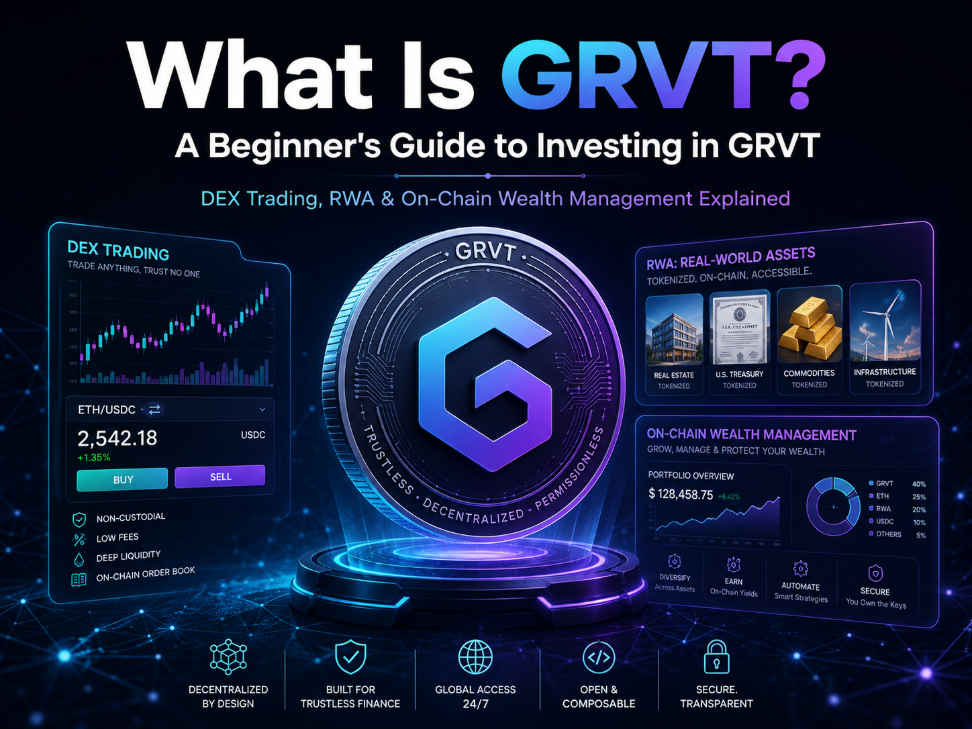
This section answers: Why should users care about GRVT when they already have Binance, OKX, and others?
CEXs excel at efficiency. Fast order execution, smooth UI, deep liquidity—but at the cost of custodial risk. What you see is a platform balance, not assets fully controlled by your own private keys.
DEXs excel at transparency and self‑custody. You trade directly from your wallet, without blind trust in the platform. But they struggle with performance—especially for derivatives, high‑frequency matching, margin management, and other advanced use cases.
GRVT aims to combine the best of both. According to the GRVT Help Center, it uses a hybrid architecture: an off‑chain system for matching and execution (for speed) and an on‑chain system for settlement, margin, risk controls, and self‑custody (for security and transparency).
That’s GRVT’s core positioning: not a copy of a CEX, nor a traditional AMM‑style DEX, but a hybrid platform that offers “CEX experience + DEX asset control.”
4. GRVT Core Technology: How Does ZK Change the Trading Experience?
This section addresses: What is GRVT’s technical moat? Why is it often discussed alongside ZKsync and ZK technology?
According to the official GRVT Help Center, GRVT is built on Matter Labs’ Elastic Chain and the ZKsync ecosystem, aiming for scalability, low latency, high throughput, and zero‑gas trading, while leveraging ZKsync Validium for transaction privacy.
For everyday users, you don’t need to master all the ZK details—just understand that it solves three key problems:
- Better performance.
- Regular on‑chain trades require block confirmations, wallet signatures, gas fees, and waiting times. That’s acceptable for spot swaps, but for order‑book, leveraged, and futures trading, it’s too slow. GRVT uses off‑chain matching and on‑chain settlement to deliver a near‑traditional order‑book experience.
- Lower costs.
- Fully on‑chain execution is expensive. ZK and Layer 2 architectures batch many transactions and state updates, then submit a verifiable summary to the base chain—dramatically cutting user costs.
- Privacy + verifiability.
- On public chains, addresses, flows, and positions are often traceable. For retail users, that’s a privacy concern; for professionals and institutions, it risks strategy leakage, front‑running, and compliance issues. GRVT uses ZK to protect trade data while keeping settlements auditable.
5. What Products Does GRVT Offer? What Are the Real Use Cases?
This section asks: Is GRVT just a concept, or is there real demand?
GRVT isn’t building a single trading page—it wants to cover Trade, Earn, Invest, and Pay all in one place. Its vision, outlined in official blog posts, is to unify the entire capital cycle—from deposit to yield, trading, investing, and payments—without sacrificing asset control.
1. GRVT Trading Features
The core entry point is trading: crypto spot, perpetual futures, order‑book experience, market‑making rebates, and professional tools. For traders, the key metrics are execution speed, liquidity, and fees. GRVT highlights its speed and privacy, plus a negative maker fee that rewards limit‑order providers—a clear play to attract professional traders, market makers, and high‑frequency users to build order‑book depth.
2. GRVT Earn Yield Ecosystem
GRVT doesn’t want users to just trade. Even when idle, your funds can generate yield—unlike traditional exchange accounts where capital sits unproductive. The goal is to let the same balance serve as both trading margin and yield‑bearing collateral.
But beginners must understand: no yield product is risk‑free. Whether the yield comes from DeFi protocols, platform fees, RWA underlying assets, or other financial structures, you need to assess smart‑contract risk, liquidity risk, underlying asset risk, and rule changes.
3. GRVT’s RWA Push: Why Traditional Assets Are Coming On‑Chain
RWA (Real World Assets) is a critical part of GRVT’s long‑term narrative. Think tokenized stocks, ETFs, bonds, treasuries, commodities, and credit assets. GRVT’s blog mentions expanding from crypto perpetuals to tokenized equities and RWA products, with plans to share a unified collateral and capital‑efficiency system across RWA vaults, tokenized stocks, commodities, and multi‑asset trading.
This expands GRVT’s potential beyond “a DEX” to “trading + RWA + yield management” combined. For context, you can read about what SOXSB is and what PYPLB is—these tokenized stock or ETF assets represent the broader trend of traditional finance moving on‑chain, a space where GRVT clearly sits.
6. What Is the GRVT Token? What Gives GRVT Coin Its Value?
This section answers: When you buy GRVT, what are you actually buying?
The GRVT token is not a symbolic “meme” asset. According to official disclosures, $GRVT has a fixed supply of 1 billion tokens with no inflation above that cap. The design focuses on linking token demand to real platform usage.
Value drivers include:
- Trading fees and utility. If GRVT’s volume grows, the token can be integrated into fee discounts, rebate mechanisms, membership perks, and other economic incentives.
- Ecosystem rights. As GRVT expands into Earn, Invest, RWA vaults, tokenized stocks, and payments, the token may grant access to product tiers, yield boosts, governance, or loyalty benefits.
- Platform growth capture. Ultimately, a trading platform’s value depends on users, volume, liquidity, AUM, product depth, and stickiness. If GRVT attracts serious traders, RWA users, and yield seekers, the token has stronger fundamentals. Conversely, if volume stays thin or RWA progress lags, token demand weakens.
7. GRVT Tokenomics: How to Assess Long‑Term Value
To analyze GRVT’s tokenomics, don’t stop at total supply. Fixed supply is just the baseline—what really matters is the circulation structure and unlock schedule.
Ask these five questions:
- Total supply? 1 billion $GRVT, fixed, with no inflation above that—good for assessing dilution, but not a price guarantee.
- Initial circulating supply? A very low initial float can cause early price volatility, with later unlocks adding pressure.
- Allocation breakdown? Team, investors, ecosystem fund, community rewards—each has different incentives. Higher community allocation boosts engagement; higher team/investor share demands close scrutiny of lock‑up periods.
- Airdrop selling pressure? GRVT has run reward programs based on volume, positions, referrals, and liquidity. Season 2 allocation was raised to 18% of total supply. Airdrops grow the community, but post‑claim selling can pressure prices.
- Is the token truly tied to platform revenue? If it’s just a “points‑style” utility, the value case is weak. If it’s strongly linked to volume, revenue share, product access, and ecosystem growth, the long‑term logic is much stronger.
8. GRVT Price Prediction: Where Could Future Upside Come From?
Many search for “GRVT price prediction 2026” or similar, but giving a precise number for a new project is unhelpful. Instead, think in scenarios.
You can check the GRVT price prediction page for additional market data, but focus on these key variables when making your own judgment.
Bullish Factors
- DEX market growth. If more users shift away from custodial exchanges toward self‑custodial trading, hybrid DEXs like GRVT gain market share.
- RWA expansion. Tokenized stocks, treasuries, funds, commodities, and ETFs continue to grow—platforms offering unified accounts, trading, and yield will be well‑positioned.
- Institutional adoption. Institutions care about privacy, security, compliance, depth, and risk management. GRVT’s ZK privacy, on‑chain settlement, and hybrid architecture could attract institutional flows.
- Rising trading volume. Volume is the lifeblood of any exchange token—if GRVT grows volume, fee revenue, liquidity, and token utility all improve.
Bearish Factors
- Intense competition. GRVT faces Hyperliquid, dYdX, GMX, and many other PerpDEXs plus centralized exchanges—all with established users, liquidity, and brand.
- Token unlock pressure. If large amounts of tokens are released shortly after listing—from airdrops, investors, team, or ecosystem incentives—short‑term price headwinds are likely.
- Market cycle risk. GRVT is a high‑risk crypto asset. If BTC, ETH, or the broader DeFi market enters a downturn, token prices may suffer even if fundamentals improve.
- RWA execution risk. RWA is a long‑term trend, but success depends on asset quality, legal structure, liquidity, compliance, and user demand. If RWA products remain conceptual without real AUM, token support will be limited.
9. How to Buy GRVT – A Complete Beginner’s Tutorial
This section answers the most common question: “How do I buy GRVT?”
Before buying, don’t chase pumps. First confirm the trading venue, secure your assets, and assess your risk tolerance.
Step 1 – Check GRVT price and trading pair.
Visit the GRVT live price page to see the GRVT/USDT price, change, volume, depth, and recent trends. If the pair is live, evaluate whether conditions suit your entry.
Step 2 – Prepare USDT.
Most crypto assets trade against USDT. You can buy USDT on a supported exchange or transfer from a wallet. For first‑time deposits, do a small test transaction to confirm network, address, and arrival before moving larger amounts.
Step 3 – Choose a trading platform.
If GRVT is already listed on your chosen exchange, search for the GRVT/USDT pair. If not listed, wait for official announcements—never buy through unknown links, private chats, or unverified contract addresses.
Step 4 – Choose your order type.
Beginners are better off using limit orders rather than market orders. New tokens can have thin liquidity, and market orders may cause significant slippage.
Step 5 – Manage your position after purchase.
Never allocate all your capital to GRVT at once. Instead, scale in gradually, set stop‑loss levels, and continuously track key metrics: volume, user growth, RWA product updates, token unlocks, security incidents, and ecosystem partnerships.
Step 6 – Beware of airdrop scams.
If you’re interested in the GRVT airdrop, always verify rules through official channels. Any site asking for seed phrases, private keys, remote wallet access, or upfront transfers to claim an airdrop is a scam.
10. How Does GRVT Compare to Other Crypto Projects?
This section helps you understand where GRVT fits in the landscape.
GRVT vs Hyperliquid
Hyperliquid is currently a dominant force in PerpDEX, known for trading experience, liquidity, and mindshare. GRVT differentiates itself with stronger emphasis on ZK technology, self‑custody, privacy, unified margin, and RWA wealth management. Hyperliquid is more of a pure‑play trading venue; GRVT aims to be an “on‑chain comprehensive financial account.”
GRVT vs dYdX
dYdX is a long‑standing veteran in decentralized derivatives. GRVT’s distinction is that it doesn’t stop at derivatives—it places Earn, Invest, RWA, and capital efficiency at the core.
GRVT vs Binance, OKX, Coinbase
These are mature CEXs with rich product suites, deep liquidity, and polished UX. GRVT’s edge is self‑custody and on‑chain settlement. Think of it this way:
- CEXs solve “ease of use.”
- DEXs solve “who controls your assets.”
- GRVT aims to solve both.
GRVT vs RWA‑focused projects
GRVT is not a single RWA asset—it’s a platform gateway for trading, yield, and collateralization of RWA assets. The future crypto market may have three roles: trading platforms, RWA issuers, and on‑chain wealth managers.
To explore different asset narratives, you can read about what MARSCOIN is and what SMHB is—the former is more crypto‑native, the latter closer to RWA and tokenized stocks. Comparing these helps you judge which category GRVT belongs to.
11. What Are the Risks of Investing in GRVT? What Beginners Must Know
To meet high‑quality disclosure standards, we cover both opportunity and risk.
1. Technical Risk
GRVT relies on ZK, Layer 2, smart contracts, off‑chain matching, and on‑chain settlement—any vulnerability could affect user experience or funds. Self‑custody reduces platform theft risk but does not eliminate smart‑contract bugs, bridge risks, downtime, or oracle failures.
2. Market Competition
The DEX and PerpDEX space is crowded. Hyperliquid, dYdY, GMX, and newer entrants are all competing for traders and liquidity. Success depends on users, depth, speed, fees, product, and security—not just a tech narrative. If GRVT fails to attract sustainable volume, token value suffers.
3. Token Unlock Risk
One of the most overlooked risks in new tokens is the unlock schedule. Even with strong fundamentals, a rapid release of tokens—from early investors, airdrop recipients, or team allocations—can weigh on prices.
4. RWA Compliance Risk
RWA isn’t just “putting stocks on a blockchain.” It involves custody, legal rights, redemption mechanisms, jurisdictional restrictions, and disclosures. Without transparent structures, investors may not fully understand what rights they hold.
5. Yield Product Risk
GRVT emphasizes capital efficiency and yields, but all yields come with risk. The higher the yield, the more you need to ask: Where does it come from? What’s the underlying asset? Is there a lock‑up? Can you exit anytime? What are the smart‑contract and liquidity risks?
12. GRVT’s Future Outlook: Could It Become the Next‑Gen On‑Chain Trading Infrastructure?
Looking 5 years ahead, GRVT’s opportunity hinges on three major trends:
Trend 1 – On‑chain trading gradually replaces some traditional venues.
As Layer 2, ZK, account abstraction, and wallet UX improve, more users—especially professionals and high‑net‑worth individuals—will shift from CEXs to self‑custodial platforms that prioritize asset control.
Trend 2 – RWA asset growth accelerates.
Tokenized stocks, treasuries, commodities, funds, and bonds are coming on‑chain. Users will need more than a “buy‑and‑hold RWA token”—they’ll need a full financial account for trading, collateral, yield, and exits. GRVT is positioning itself as that infrastructure layer.
Trend 3 – DeFi and traditional finance merge.
DeFi won’t just serve crypto‑natives—it will serve global investors holding stocks, bonds, ETFs, commodities, stablecoins, and on‑chain funds. If GRVT can unify trading efficiency, self‑custody, RWA, and yield, it could become part of a new on‑chain wealth management ecosystem.
GRVT’s success also depends on the broader Ethereum ecosystem and Layer 2 development. You can monitor ETH price predictions to gauge the health of Ethereum, ZK technology, DeFi flows, and RWA momentum.
13. Summary: Is GRVT Worth Investing In?
GRVT deserves attention—but not as a “next moonshot coin” to be understood simplistically.
Strengths:
- It takes a ZK‑powered, self‑custodial approach to bridge CEX trust issues and DEX performance gaps.
- It goes beyond trading, aiming for Earn, Invest, RWA, and unified capital efficiency.
- It sits at the intersection of multiple powerful narratives: DeFi, PerpDEX, RWA, tokenized stocks, and on‑chain wealth management.
Risks:
- Fierce competition from Hyperliquid, dYdX, GMX, and centralized exchanges.
- Token listing, unlocks, airdrop selling, and market volatility can pressure prices.
- RWA and yield products face regulatory, asset‑quality, and user‑adoption hurdles.
GRVT is best suited for:
- Investors who believe in long‑term DeFi infrastructure.
- Those willing to research ZK, DEXs, and on‑chain trading platforms.
- People tracking RWA, tokenized stocks, and on‑chain wealth management trends.
It is not for beginners who just want to short‑term chase pumps without studying the mechanics or managing risk.
For any newcomer, the most important steps before investing in GRVT are:
- Understand the project’s positioning.
- Watch real trading data and tokenomics.
- Start small, scale gradually, and only risk what you can afford to lose.
In crypto, opportunities are abundant—but the investors who survive long‑term aren’t the boldest chasers; they’re the ones who best understand risk.